
A Realistic Timeline for Building a Custom Home in Costa Rica, From Land to Keys
Most owners arrive with one question: how long will this take? The honest answer is that a custom home in Costa Rica is not slow because building here is difficult — it is different. The sequence of approvals, the rainy season, and the distance between a design drawing and a delivered material all shape the calendar. Below is the timeline we plan against, phase by phase, and the things that move it.
These are planning ranges, not promises. A 180 m² home on a flat lot near Tamarindo and a 400 m² home on a slope in Puerto Viejo de Limón do not share a schedule.
The phases, in order
1. Land due diligence and feasibility (weeks, before design)
Before anyone draws a house, we confirm what the land can legally hold. That means checking the title and survey, the zoning and permitted use, setbacks, and whether water and power can actually reach the site. Water availability is the item that surprises people most often — a lot can look perfect and still lack a viable connection.
Skipping this step is the single most reliable way to lose months later.
2. Design and engineering (a few months)
This is where the drawings become buildable: architectural design, structural calculations, mechanical and electrical plans, and the specifications that let us price the work properly. Tropical design choices — deep roof overhangs, cross ventilation, drainage — belong in this phase, not after the foundation is poured.
Owners who finalize selections here save time later. Owners who keep changing scope here add weeks to everything downstream.
3. Permits and approvals (the variable that decides your start date)
Construction in Costa Rica runs through municipal permits alongside national-level requirements: structural plan review with the CFIA, set-back and use confirmation from the municipality, environmental screening where the site or scale requires it, and water and power availability letters.
Each approval has its own queue, and they are not always parallel. In our experience this phase is where a schedule is won or lost, and it is strongly influenced by how complete and consistent the submission package is the first time it is filed. Corrections requested by a reviewer restart the clock.
The practical implication: the permit phase should be planned as its own stage with its own duration — not treated as paperwork that happens during design.
4. Site preparation and foundation (the first month on site)
Clearing, access roads, excavation, and the foundation. Slope, soil, and access determine how much work this is. On the Caribbean side, drainage and water management during earthworks deserve more attention than most owners expect.
5. Structure and roof (the phase that must respect the season)
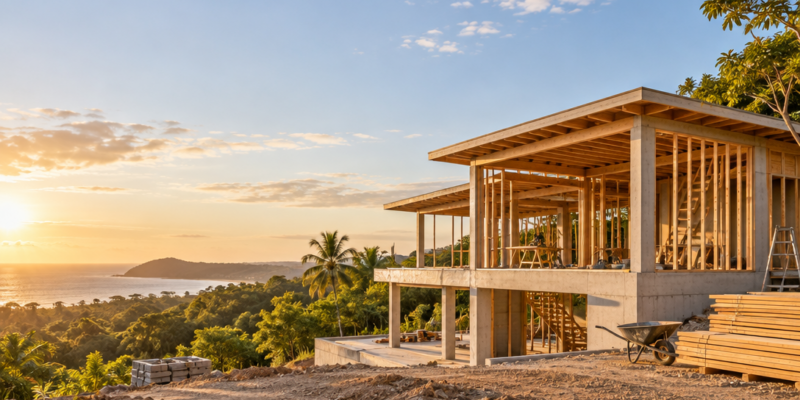
Frame, walls, and roof. Getting the roof on is the milestone that protects everything after it, which is why we sequence it aggressively. In Guanacaste the dry season is a genuine scheduling advantage for this stage; in Puerto Viejo de Limón, rain is a constant and the plan is built around working through it rather than waiting it out.
6. Rough-ins, finishes, and systems (the longest visible phase)
Electrical, plumbing, and mechanical rough-ins, then insulation, drywall, tile, cabinetry, painting, and fixtures. This is where the house starts to look like the renderings, and where selection delays surface. A finish that has to be imported adds lead time that no amount of on-site labour can compress.
7. Pool, landscaping, and closeout
Pools, exterior works, landscaping, and the final inspections and utility connections. On tropical homes we plan landscaping as part of the build, not an afterthought — it is what makes the property feel finished, and it is easier to coordinate with the same crew on site.
What actually slows a project down
In our projects, the same handful of issues account for most of the lost time:
- Incomplete permit submissions. Each correction cycle costs weeks.
- Late or changed selections. A cabinet or tile decision made after rough-in can force rework.
- Imported materials ordered late. Shipping and customs clearance are not compressible.
- Land problems discovered during construction. Water, access, or boundary issues found after mobilization are the most expensive kind of delay.
- Unrealistic rainy-season expectations. Concrete, painting, and excavation behave differently in heavy rain. A plan that ignores this slips.
How we keep a build on schedule
We plan, budget, permit, and administer the project ourselves, which means one team owns the calendar instead of three that blame each other. Concretely, that looks like:
- Feasibility checks before design starts, so the design fits the site and the rules.
- A permit package assembled complete the first time, with the structural and municipal requirements coordinated.
- A construction schedule that puts the roof before the rainy season wherever the site allows it.
- Selections locked before the phases that depend on them.
- Clear, bilingual reporting so owners abroad are not guessing what happened this month.
Planning your own timeline
If you are weighing a build in Tamarindo, Puerto Viejo de Limón, or somewhere in between, the useful first conversation is about your land and your program, not about a finish date. Tell us where the lot is and what you want to build, and we can tell you which phases will run long and why — before you commit to a date you will have to explain to your family.
We have been building in Costa Rica since 2005. If you want a schedule you can actually plan around, start with the land.